A New Design Philosophy Focused on Aerodynamics
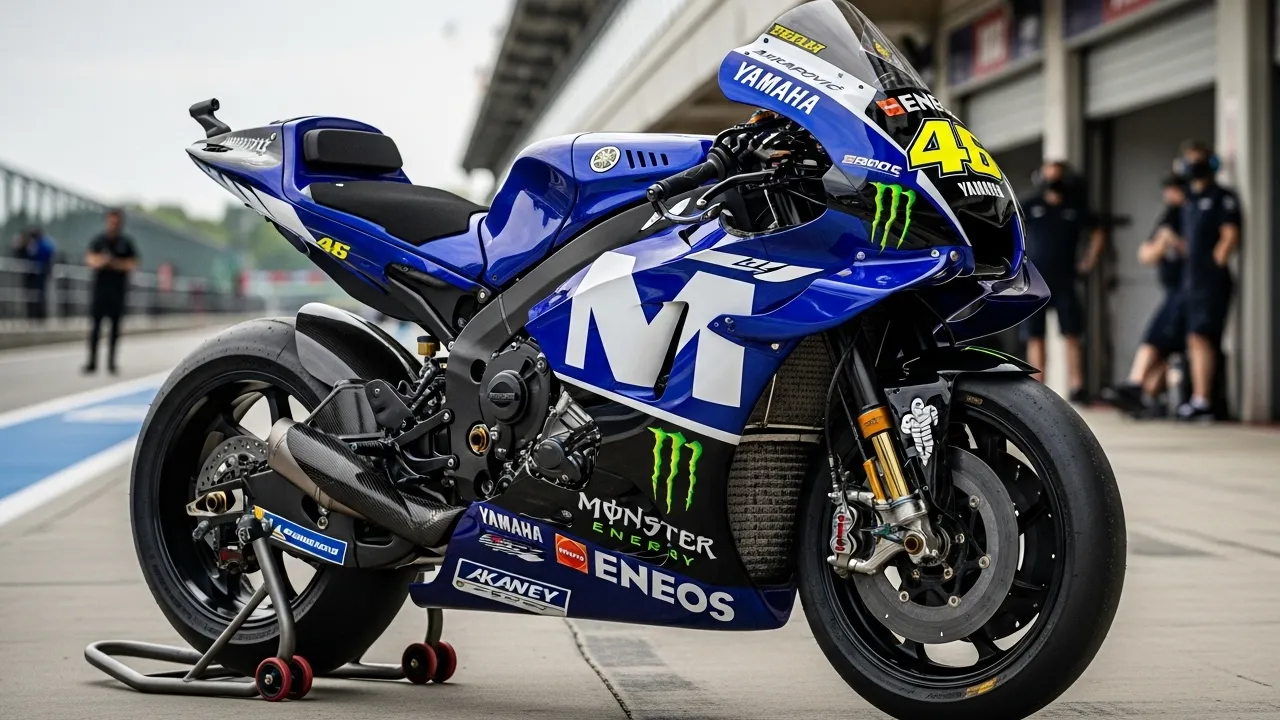
At first glance, the YZR-M1 V4 2026 looks sharper, more compact, and far more aggressive than its predecessor. While Yamaha’s iconic Racing Blue remains intact, nearly every external component has been redesigned to optimize airflow and stability.
The revised fairing features advanced aerodynamic winglets that generate controlled downforce without increasing drag excessively. This improves front-end grip during braking zones and enhances stability at high lean angles. In modern MotoGP, where milliseconds are gained through aerodynamic balance, these refinements are crucial.
V4 Engine: Why Yamaha Finally Made the Switch
The heart of the Yamaha YZR-M1 V4 2026 is an all-new 1000cc MotoGP-spec V4 engine. This decision ends decades of Yamaha’s loyalty to the inline-four configuration — a layout known for smooth power delivery but increasingly limited under today’s regulations.
The V4 engine provides stronger mid-range torque, improved rear-wheel traction, and more flexible packaging for aerodynamics and chassis balance. These advantages directly address Yamaha’s historical weaknesses on corner exit and straight-line acceleration.
Extensive development work has been carried out by test rider Augusto Fernández, with valuable input from factory racers Fabio Quartararo and Álex Rins. Their feedback ensured that power delivery remains predictable — a defining Yamaha characteristic — while still delivering competitive performance.
Fuel Efficiency and Race-End Consistency
MotoGP success is not determined by peak horsepower alone. With strict fuel limits and long race distances, fuel efficiency and thermal stability play a decisive role. Yamaha engineers focused heavily on optimized combustion efficiency and advanced fuel injection strategies.
The YZR-M1 V4 maintains consistent lap times throughout the race, reducing performance drop-offs in the final laps. Stable engine temperatures and refined throttle mapping allow riders to attack late in the race without sacrificing control or tire life.
Advanced Electronics and Rider Support Systems
The electronics package on the Yamaha YZR-M1 V4 2026 is among the most advanced ever developed by the brand. Yamaha has balanced cutting-edge technology with rider-friendly behavior to preserve the natural feel riders demand.
- Advanced traction and slide control
- Adaptive engine braking management
- Real-time telemetry and data analytics
- Chassis balance optimization systems
- Aerodynamic stability integration
These systems allow engineers to fine-tune the bike for different tracks, tire compounds, and weather conditions, giving Yamaha greater strategic flexibility across the 2026 season.
Prototype Exclusivity and Development Cost
As with all MotoGP machinery, the Yamaha YZR-M1 V4 2026 is not available for public purchase. Each unit is a hand-built prototype developed exclusively for Yamaha’s factory racing program.
Industry estimates place the development and operational cost of each bike between ₹2–3 crore per season. This reflects the extreme engineering precision, continuous development, and data-driven refinement involved in MotoGP competition.
2026 MotoGP Debut Expectations
The YZR-M1 V4 is expected to make its competitive debut during the opening phase of the 2026 MotoGP season. Misano is widely viewed as one of the first major evaluation circuits, where Yamaha will assess race pace, tire management, and long-run consistency.
While immediate championship success is not guaranteed, early data suggests Yamaha has significantly narrowed the performance gap to the leading manufacturers.
Key Technical Highlights
- Engine: 1000cc MotoGP-spec V4
- Power Delivery: Strong mid-range torque and improved acceleration
- Chassis: Lightweight frame with revised geometry
- Aerodynamics: Advanced winglets and redesigned fairing
- Electronics: Full rider-assist suite with live telemetry
- Debut: 2026 MotoGP Season
Final Verdict: A Strategic Reset for Yamaha
The Yamaha YZR-M1 V4 2026 is more than a new race bike — it is a strategic reset for Yamaha’s MotoGP future. By embracing V4 architecture, advanced aerodynamics, and intelligent electronics, Yamaha has taken a decisive step toward long-term competitiveness.
This machine represents intent, not hype. Yamaha is no longer reacting to rivals — it is building the foundation for sustained success in the modern MotoGP era.